Mostrando entradas con la etiqueta SECONDARY. Mostrar todas las entradas

lunes, 9 de mayo de 2022

ÓSCAR FUENTE

 In the following lines I am going to explain one of the activities that I use in lower levels of ESO, specifically the first and second course. It consists in the designing of a healthy and balanced diet – and a posterior presentation to the rest of classmates – using authentic leaflets and pamphlets that can be found in supermarkets and mailboxes.

Every year I practice this activity coinciding with those units that deal with topics related with grocery, sport, healthy and balanced diet, etcetera. Moreover, in the design of the activity, I give to the students a copy of an original and authentic leaflet of a foreign and British supermarket and students love it. They are excited when they have a real foreign leaflet in their hands.

Let’s move to the development and timing of the activity. First of all, it is an activity (preparation + presentation) that has a duration of three sessions. In the first two sessions students have to analyze the leaflet and choose those products that they want to include in a menu for a whole day including the following meals: breakfast + lunch + afternoon snack + dinner. Students have to take into account calories, properties, and price of every product because they have a total budget of 30£. As it is obvious, they have to design a balanced diet adjusting the price without exceeding.

In the third and final session, students present to the rest of the classmates their menus. They can prepare a Power Point presentation with photos, nutrients data, price breakdown, and everything related to their grocery list.

In a nutshell, I totally agree with Shawn Redwood when saying that authentic material motivate and promote creativity of students. I claim that students get more involved in the design of the activity and, from my personal point of view, it is really encouraging. Moreover, it is an activity that adjust very well to every student considering the different levels that we have at class. Every student feel involved in the dynamic and as I said before, they enjoy working with this materials.


MÓNICA CENTENO

 LEVEL: 2ND YEAR OF ESO

Students will start the lesson by doing a "See, Think, Wonder" routine. For this, I will show them the following picture:


And they will answer orally the following questions:
- What do you see? - What do you think it happened? - What do you wonder? Three of the stronger students will write down the answers on the blackboard. After this warm-up activity, we will work with the following Mini Page (click on the image below):

They will read it in groups of four (mixed ability groups) and they will try to understand the information and the most important words. I will explain them all the information about "St. Patrick´s Day", its cultural background, Ireland as a country, the tradition and the vocabulary related to the topic. For the stronger students, they can check the following links provided on the Mini page in order to get more information about the topic as an open ended activity:


Finally, they will find the words on the puzzle in order to revise the vocabulary and they will write a short essay giving the important facts of the tradition.

martes, 3 de mayo de 2022

JUAN ENRIQUE LABAJOS

 TITLE OF THE ACTIVITY: SENSUOUS GIFTS


DESCRIPTION:

Each student imagines they are giving five presents to a person they love and five to a person they hate. The five presents to a person they love will be pleasant experiences – not things but experiences like for example the sound of a string quartet or the taste of chocolate, they’re giving them an experience for each of their senses.

The main objective is to use sensual imagery for lively and personal description.

The final output task will be to write a love or hatred poem.

The students will work in small groups of four participants. The distribution of the groups will be done mixing students with different levels, so collaborative work will be a must.

With regard to the material, some pieces of paper and sellotape or post-it stickers are needed.
PROCEDURE:

*First session:
As a warming-up activity, students are handed-in photos showing people giving and receiving gifts. They have to look at them and speculate about different aspects of gift giving such as people's emotions and feelings. Adjectives ending in - ING/-ED will be elicited.

Next, they read some statements with expressions or collocations including the word gift like:

-"A gift horse does not look at the tooth". -"The heart of the giver makes the gift dear and precious". -"Take this gift as a pledge of our friendship"- - "Shall I take my host family a gift?" -"Love is always my love to you. Happy Birthday!" - "Your gift will make room for you". They have to try to guess their meaning and match it with some of the photos if possible. Once they have read them, they have to decide whether they agree or disagree with them, providing examples. After that, they will also practice their listening skills by watching a video clip from “Friends”. After watching, they need to share their experience of giving and receiving gifts. The class is divided into groups of four students and they brainstorm experiences they really dislike. *Second session: They try to connect their considered experiences to the five senses. It is important that at the end of this stage there is at least one experience related to each one of the five senses.
Then they do the same with experiences they like very much or love. Again it is important that all five senses are represented.
The whole class brainstorm collective terms, which can be fairly everyday (e.g. a handful of, a lorry load of, tons of, etc.) or rather imaginative (e.g. a nostril full of, a breath of, a morning full of, etc). These are written on small pieces of paper and hung up all over the classroom. *Third Session:
Using the collective terms they find appealing and the nice experiences, they will write a love poem, and with the nasty experiences, a hatred poem. The speaker of each group will read out the poems and let the other groups know for follow-up discussion.


IRENE LÓPEZ

Skills: Listening and Writing 

Level: 1 st Grade Bachillerato 


Skill 1: Listening. The students will be given different sheets of paper and they have to follow the instructions individually as required in the table.


Skill 2: Writing. After the listening, they must write a description about Héctor Bellarín according to the information previously listened to. Once again, each student will have deliberated instructions that they have to follow. Both groups can use the dictionary when they need. The writing must include, at least, those items:


viernes, 29 de abril de 2022

HARMONY PRINGLE


LEVEL: 3/4 year of ESO

RESTAURANT REVIEWS: A READING (AND WRITING) ACTIVITY

I often find that textbooks try to get students to read/write reviews that are 3 or 4 paragraphs long, something they surely don't see in the real world. Let's be real: they don't read the newspaper. I'd rather them gain skills they can apply directly, even if it means shorter reading and writing samples.

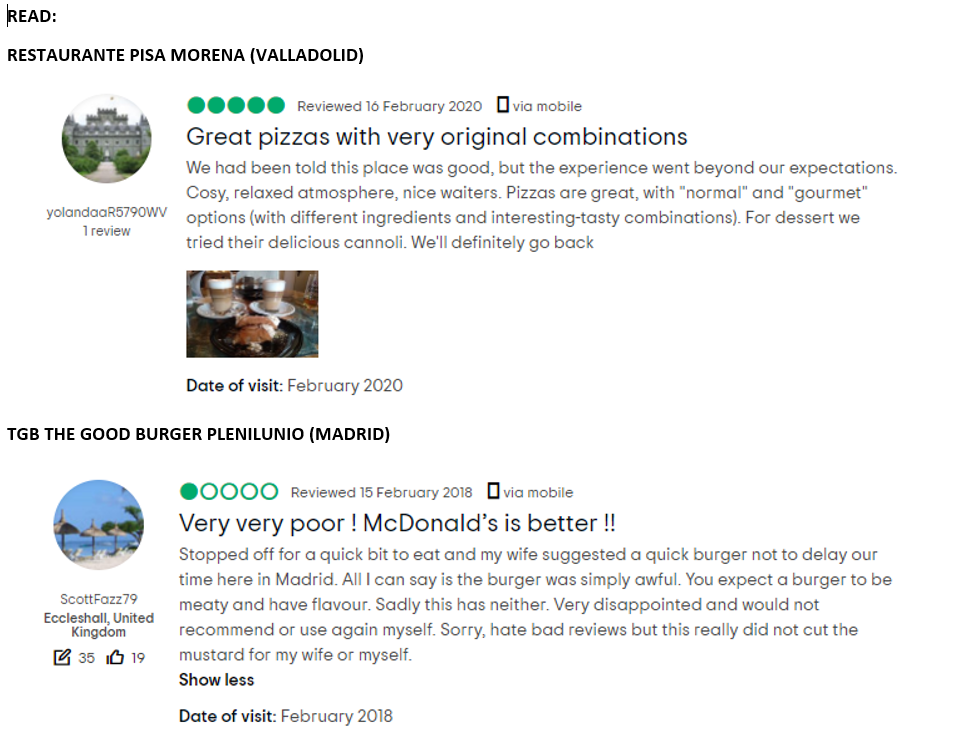
Here's an activity using real reviews from TripAdvisor. The texts (one positive, one negative just to spice things up) can be found in the link. PRE-TEACH: Pre-teach the word "review" using a photo, a screenshot or just a drawing of 3/5 stars. Remind students it can be positive or negative and that the purpose is to describe and recommend. THINK/PAIR/SHARE: Do you ever use reviews when choosing something? Have you ever written a review (amazon, videogame sites, a restaurant, etc.)? READ: Read the two restaurant reviews. ACTIVITY: Read the two reviews again and then answer the following questions in your notebook. Content: Fill in the information from the two reviews. (You may not be able to fill in every section.) *You may need to define "service" in this context.
Restaurant: Place: Food: Service*: Recommendation: Language:
1. Identify the titles in the two reviews. 2. Write down all the adjectives you can find in the two reviews. 3. Write down all the adverbs you can find in the two reviews. 4. Find an example of a contraction (two words joined by an apostrophe). 5. Find an example of a sentence fragment (a sentence without a conjugated verb). *DIFFERENCIATION*
LOW: Make sure you go through each step with the students: pre-teaching, TPS, reading, and the activity. You can answer questions/define words along the way. You could also do the content/language question for the first review together and then have students answer the questions for the second review in pairs.
HIGH: Higher level students should be able to do most of this activity independently. You could challenge them by having them work with a lower level student, appoint them the "Vocabulary Master" of the activity as Shawn mentioned, or get them to write their own review in the same style for homework.


lunes, 25 de abril de 2022

AIDA EMILIA MÁRQUEZ


LEVEL: 1st year of ESO

 Vampire Baseball


In a mixed-ability class, students will watch a clip from the film Twilight where vampires are playing football (from 00:20 to 2:14. First, they will watch it and then teacher will ask them to

1- Describe the scene (Ellicit information regarding weather, place, actions, characters: clothes and physical description)

2- Describe what vampires can do in this clip.
These two questions will be answered orally so that they can practise their oral skills. As they are very open questions, they will allow both weaker and stronger students to provide information for each one on their own level. Therefore, in the case of the second one, they can make sentences like “They can jump high” (weaker students) or “they can juggle with a baseball bat” (stronger students).

Finally, the teacher will ask them to make a podcast. Stronger students will be paired with weaker students. The stronger ones will play the role of vampires that are interviewed by journalists (weaker students) about their lives as vampires. The weaker students will prepare the questions. The teacher will provide them with some ideas like: “How did you become a vampire?” “Can you describe the place where you live?” The stronger students may help them if necessary. Once the questions are written, the stronger students will work on the answers. Then, both of them will record the interview together.


ALEXANDRA BEDELEAN


Skill: Speaking

Level: 1st year of Bach

Topic: Discuss about the effects of the full moon on people. Students often complain about being tired or experiencing low energy periods at certain moments of the month. One of my students, who is passionate about astrology and spiritual activities inspired me to create this activity, after investigating a bit about the topic. One of the resources I used is: (Click on the photo below) 


This is a very useful website where you can read articles about lifestyle, nutrition or health, as well as watch podcasts about different topics.

Steps to follow: divide the students in groups of 4 or 5. Each group discusses about the topic I give them on paper or project on the board. They have five options to include in their conversation and then they have to reach an agreement on which ritual would be the most effective in reducing the effects of the full moon on people. Weaker students would be included in each group so they can state their opinion and ask for help among their partners.

Objective: state their opinion on a certain topic, using expressions of agreeing and disagreeing.

Exercise: 


Mª CRISTINA GARCÍA


LEVEL: 1st year of ESO

The activity is designed for a group of 1Year Eso and it is meant to be done by each student using their own Chromebook or laptop . It is programmed to last around one hour and to be done during a class session. Its main objectives are based on the development of the students´digital competences and their English writing skills.

The first step is to watch a video in the platform Youtube. It is a Disney Pixar short film. They are told yo pay attention to all the details carefully. The level of comprehension is low because the characters do not speak so all students will be able to get the information they need for the further exercises.

In a second phase, they are given a google document link in which they have different questions on the short film they have watched. The questions are designed to be accesible to all the students of the class. There are some short questions that required very basic answers such as:
-Who were the characters? - What is the big alien´s job? - Did the small alien pass the test? why? - Where and when does it take place? There are also questions in which higher level students will be able to use their skills and weaker students could answer briefly.
-What is the short film about? Make a summary - Find a picture or freeze frame of the pilm, paste it in the doc and describe it. Finally, there are some questions so that they can express their opinion on the topic that the short film presents. There is room for longer os shorter answers, they are told to support their arguments only if they feel confident about how to do it based on their writing abilities. -Do you believe we are alone in the universe? Why? -Do you believe in aliens and UFOs? Why or why not? - What do you think aliens might look like?
During the session , they can unse dictionary online and the teachers support. The send the final product to our google classroom virtual class. Each student is assessed taking into account skills, effort and result of the activity.


viernes, 22 de abril de 2022

Mª JESÚS MARCOS

 Activity: VIDEO " THE GIRL EFFECT "


Target group: 4 ESO
Skills: Reading , Speaking and Writing.

For Women´s Day I chose to play a video called “ the Girl effect “ . I did different activities about

1.-BEFORE WATCHING THE VIDEO :

I asked students to think about the differences in life between a teenage girl living in an underdeveloped country and the life of a girl living in any European country.
2.-AFTER WATCHING THE VIDEO:
For weaker students :

I asked them to draw a lifeline of a teenage GIRL in poor countries and another one of another girl after getting EDUCATION :

Girls in Poor ___________________________________________________ Countries 12. 14. 15. 18. Girls in Developed ___________________________________________________ Countries 12. 14. 15. 18.
For stronger students :

I asked them to answer the following questions: 1. What happens when a girl turns 12 in underdeveloped countries? 2. When does she usually get married? 3. What are the problems she has to face later? 4. How could this situation be avoided?
3.-WRITING: Creating a blog or a TV advert .

I told my students that they and their friends were taking part in a campaign to get funds to improve girls’ education in underdeveloped countries and for that reason they had to Create a blog or a TV advert in groups .
2.- DISCUSSION:

This activity was carried out in two teams, mixing weaker and stronger students so that they could help each other. Each group had to defend a different position about the topic. Will “the girl effect” help to reduce poverty ? Why? Why not ??
“ the Girl effect “ is a video that is really worth watching ,students love it and make them think about how different “ A Girl’s Life “ can be depending on where they are born .


jueves, 21 de abril de 2022

MACARENA DELGADO

How Much Sugar?

Grade Level: 3 rd E.S.O; Subject: Biology

As the amount of sugar is to high the common foods the aim of the project is to find out whether people are aware of the amount of sugar found in everyday foods.

The purpose of this activity is to measure out the sugar of various foods and find out whether people can correctly determine how much sugar is in certain common foods.

Humans crave sugary foods for a good reason. Sugar packs a lot of calories into a small amount of food. We pack sugar into many foods we wouldn’t think to find it in and overload our systems to the point where we can develop diabetes. Much of the sugar we consume every day is hidden in foods that we wouldn’t expect to find it in.

Materials:

• At least 2 kg of sugar
• A scale
• Various everyday foods (you can use processed foods like soda, candy, and crackers that display the sugar content on the label as well as raw foods such as fruits, vegetables or grains and find out the sugar content on the internet)
• Plastic bag
• Glue, cardboard,scissors,etc..

Procedure:

Students will be divided into mixed-ability groups and they will have the following instructions:

1. Collect a number of different foods that you would like to see the sugar content for.
2. Using a scale, measure out the amount of sugar in your first food.
3. Place the sugar in an empty small plastic bag.
4. Label the plastic
5. Bag to show how many grams of sugar you placed in it.
6. Repeat steps 2-4 for your different foods.
7. Record the results.
8. Design and create a poster to show the results.


VIRGINIA NAVARRO

 LEVEL: 1st year of ESO

  • Scaffolding authentic materials

I will present the following pictures to the students (Click on the photo below) 


Source: http://www.cellimagelibrary.org/browse/celltype

This is for finding out what learners already know about the science topic. Brainstorming ideas about the new topic. This is planned for whole class work. I let them say some words or ideas in L1 and then translate. start with a question: What can you see in the picture? Are all the photos the same color, shape, etc.? What is the instrument below? What is it for? Can you see cells with your naked eye

  • Using K-W- L chart

Students draw the chart in their notebooks and comment it to the whole class


  • Using graphic organizers with illustrations to offer a visual support 

Basically, the graphic below has got the same information as the text shown in activity number 5. The graphic is taken from an English website, ThoughtCo. 

Click on the photo to read the article


  • Asking questions about the graphic above

Look at the picture above. Answer the questions below:


·         Do all cells have similar chemical composition?

·         What is the basic unit of life?

·         What are all living organisms made of?


Attention to diversity. ACTIVITIES

*For stronger students:  

To make a Graphic organizer using ICT,  e.g. Mindmeister: https://mm.tt/map/2247714119?t=U0NZSBw7DB or in your notebook.// Write questions about the graph//Add more information or examples on the mind map.

* For weaker students:

To write down new vocabulary and explain it using visuals.// Give them the graph with information-gap to fill in, in pairs.


martes, 19 de abril de 2022

JESSICA CHURCH


This activity is inspired by various courses that I've done with Shawn. I have decided to incorporate See-Think-Wonder with laminated pictures (CLICK ON PHOTO)


I have prepared seven for this particular task because I will use them in a group of 3º ESO that has 20 students. This way each group of three will have a different laminated card. I also know that, since students will have a different card each day, I will be able to use this ice breaker in seven different sessions with the same class.

I use See-Think-Wonder with students in all of my courses and it has proven to be a fantastic way to include Attention to Diversity within the classroom. It offers stronger students the opportunity to really expand and use the vocabulary and grammar that they know (while unintentionally "teaching" their peers), and weaker students are also able to successfully participate with the vocabulary and grammar that they know.

I also like to see how students become more astute at asking more thought-provoking questions once they have done this activity more than once. This provides more opportunities for Attention to Diversity, because it allows students to use different intelligences--students who may not have a high level of English can still be stronger when it comes to critical thinking or interpersonal relations, for example.

During the course Shawn encouraged us to create "reusable" materials, and long-term these laminated mats would ideally be used as an ice breaker at the beginning of class throughout the year.

Timing: +/- 12 minutes at the beginning of class (icebreaker)

Sequencing:

1. Students will sit in groups of 3 and will be given one of the laminated pictures, which will be placed in the middle of the group. They will have around 3-4 minutes to work individually, completing a see-think-wonder chart in their notebooks.

2. Students will share their ideas within their groups (3-4 minutes)
3. As a class, groups will share their different observations and questions.

Shawn always stresses the importance of using images to get our students engaged and thinking--I hope that this activity does just that! (CLICK ON THE PHOTO BELOW)


Mª TERESA FERNÁNDEZ

 Activity: Guess the topic.

Target group: 2 Year of ESO.

Skills: Listening, speaking and writing.

The aim of the activity is to guess the next topic to be talked about in the class. We watch the first 10 seconds of Ed Sheeran´s commercial without audio. Then, they give ideas about the topic. Most of them say: "Music" so this is the right moment to ask them about their favourite type of music, song, singer or band, when they listen to music, where and so on. This is a great idea to encourage them to speak and interact with each other.


But, I tell them that this is not the real topic (sounds of disappointment!!). However, I explain that at the end of the lesson, I attach a link with one of Ed Sheeran´s song.

Next, we watch the whole commercial with audio and when it finishes all of them say: "Food". Bingo!! It is time to start working with vocabulary and questions related to the topic. First, I boost them to say the words related to food and restaurants they have just seen in the commercial. Second, it is time to ask them to write on the board the name of the meals and introduce questions like: What´s your favourite meal? or food? What do you usually have for breakfast?.

Finally, it is time to brainstorming food vocabulary. Students are divided into two teams and I draw on the board word clouds with headings like: Fruit, vegetables, meat, drinks, dairy products... Ready, steady, go.... one student from each group go to the board and write one word in one of the clouds and they hand off the chalk or marker to the next student in their team . This student runs to write another word for his/her group. After each student has participated, we make a revision of the pronunciation as a whole group and I add some new words and expressions.

The topic of food has been introduced in a different way and even the shiest and low level students are involved. As a reward they can work with the activity related to the song by Ed Sheeran working at the same time with the listening skill (CLICK ON THE PHOTO BELOW)


JARA MARÍA FERNÁNDEZ


Be a surfer


(CLICK ON THE PHOTO TO READ THE ARTICLE)

Show the picture of a surfer.  Ask your students to write a 6-Word-Memoir of this picture on padlet about what they think of when they see the picture.

Pre-teach some difficult vocabulary of the article and write them on the board for weaker students to refer to. Draw attention to the title and subtitles. Ask them if they agree on the ideas in cooperative teams (group weaker students with stronger ones).

Break the text into chunks and ask them to read individually just one and share what they understood in teams. Ask early finishers to explain by written difficult vocabulary to the rest of the team.

Ask them to choose a profession or a sport whoch can be inspirational and how. Weaker students will write subtitles and stronger students the corresponding texts.

Ask their teams to select one picture to exemplify this text. They will create a genially and will share it with the whoe group on Teams.

lunes, 18 de abril de 2022

Mª TERESA GARCÍA

 My subject is Educación Plástica Visual y Audiovisial. In this case, the activity is for 1st ESO.

This year, they are an homogeneous group. However, I will form mixed ability groups with a stronger student, a weaker student and two average students.

Firstly, students learn in class about the basic elements of the visual language, Gestalt laws, colour, and how people had obtained them throughout the history.


Secondly, this is an activity that is proposed in the classroom based on SEE/THINK/WONDER AND CONNECT and it is to review the topic. The teacher will show the image in the screen and in groups of four people they will have to complete the task of contrasting and comparing. At the end they will explain their conclusions and we will do a great Contrast and Compare with the ideas of the whole class.


Last but not least: CONNECT. With their mobile phones (With COVID we aren´t allowed to use the PC´s Classrooms Maximum capacity: 17 students vs Real Classroom 1st ESO: 27 students) they search on the internet about the two artist (one of them is unknow and alive). We will have, at least, 6 groups of 4 students. They should say ( 6 adjectives/adverbs per group):

- Society in Vermeed´s epoch
- Society in the Bansky´s epoch
- Colours, materials in Vermeed´s epoch
- Society in the Bansky´s epoch
- Ways of learn in Vermeed´s time
- Ways of learn in Bansky´s epoch

The activity could be improved with videos or other resources

Mª VICTORIA DE LERA


The activity is called “influpoets”. The main objective is to give the reading promotion plan of my fourth of ESO students a fresh start. The idea came up last year as soon as we saw AMANDA GORMAN become world famous when she recited “THE HILL WE CLIMB” at the inauguration of Joe Biden´s presidency.


I didn´t miss the opportunity to work the poem in class and contrary to some students belief, most of them loved it. It is clear that thanks to Gorman´s brilliant declamation, more and more young people have begun to read and love poetry. This year I decided to go further in that way by giving a try to the instapoets.
The idea came up while scrolling Instagram and found out Rupi Kaur´s poems. Then, I discovered more poets that publish their works on Social Media; they are easy to read but at the same time they are quite meaningful for the students. I tried to look up and I found this article https://www.vogue.co.uk/article/best-poets-on-instagram. We read it in class, and we decided for Rupi Kaur https://www.instagram.com/rupikaur_/
First of all, we worked some of her poems in class in order to provide students with some scaffolding when analysing poems. Besides, in order to work the four skills, I raised some debate questions about one of her poems concerning first love and its relevance in one´s life

YOU MIGHT NOT HAVE BEEN MY FIRST LOVE
BUT YOU WERE THE LOVE THAT MADE
ALL THE OTHER LOVES
IRRELEVANT
by Rupi Kaur

With this other poem, I divided the class in groups and while using cooperative techniques (think-pair- share), they haye to come up with reasons in favour of /against being friend with your friend. Finally, they have to take turns to present their opinions
YOU ASK
IF WE CAN STILL BE FRIENDS
I EXPLAIN HOW A HONEYBEE
DOES NOT DREAM OF KISSING
THE MOUTH OF A FLOWER
AND THEN SETTLE FOR ITS LEAVES
-I DON'T NEED MORE FRIENDS
The last part of the activity was to create a free verse poem, draw a meaningful picture of it and finally record it with https://info.flipgrid.com/. In this way, students work the productive and receptive skills in an integrated way. They were given a poem assessment and a poem declamation rubric. Both of which were used by their peers for peer assessment.

Mª ISABEL GEJO

 Propaganda and World War I


Propaganda is a specific type of message presentation aimed at serving an agenda. Historically, the most common use of the term is in political contexts, such as war, treaty, truce, etc.; in particular to refer to certain efforts sponsored by governments or specific political groups to actively engage a civilian population in a specific type of conduct (e.g. hating an enemy nation, enlisting in the armed forces, buying war bonds, saving resources, etc.).
With only a small army and no policy of conscription upon entering WWI (1914), Britain responded to the urgent need for more men by quickly releasing a steady flow of recruitment posters. There are many posters made in 1914 to appeal British citizens to join the war.
We can see through the Imperial War Museum Collection the range of emotional, practical, and patriotic ways men were called to arms. The collection also includes posters aimed at people not eligible for recruitment, asking: “If you cannot join the army - try & get a recruit”, “To the women of Britain ... won't you help and send a man to join the army to-day.” Whether it was for political reasons, a sense of adventure, a sense of duty or purely for financial reasons, thousands of men did enlist, and thousands were killed or wounded on the European battlefields of the Great War.
Students must examine these examples of World War I propaganda (=POSTERS as primary historical source): -Britons. Join Your Country's Army! -Remember Belgium. Enlist To-day -Women of Britain say 'Go!' -Remember Scarborough -FORWARD! For weaker students: -Pre-teach difficult vocabulary (Great War, conscription, Treaty of London (1839), military strategy, propaganda, air raid, aid effort, the Allies, Triple Alliance, zeppelins, U-boat, etc.) -Write and explain the formal part of a poster: a message and audience in mind, design (title, graphic, text). Then, students must identify these parts in the posters . -To finish, students must rewrite the title or the message of the posters and modify their formal parts partially. For stronger students: -Students must consider the following questions to analyse the posters: 1. What is the perspective of the artist? How is this evident in the painting's details? 2. What is the country of origin of the poster? How do you know? 3. To what extent are details exaggerated? 4. To what extent do the scenes depicted inspire the viewers and unite them behind a common goal? 5. What ideas are present and how are they promoted (both visually and in captions)? 6. You may also want to consider observations about the human subjects themselves, gender, ethnicity, age, style of dress, etc.
-Finally, students must design their own war poster (from WWI) using the elements discussed in class after the analysis.


Mª JOSÉ FERNÁNDEZ

 The level I teach is Secondary Education (Technology)

The ideas during this class are very useful; in fact, and I describe below how I would use her ideas and tips.

1- To start the class, On Monday morning, after the weekend without practicing English, I would focus in an easy topic e.g. “What is special about today?” so we may attract our students to start speaking.

For example on 11st February is the day that Edison was born so that day may can introduce a video showing how discovered of the electric light. Even I´d show them a video of “How light bulls are made?”


2- The next step would be write some answers instead questions about the previous videos and ask them to write the appropriate questions.

I also use the transcription of the video and ask them to fill some missing relevant words. Another task could be put a words in the right order.

3- If we have time we can continue discussing in a team work the topic but giving some guides:

-What I already know
-What I want to know
-What I learn

4.The following day we work in a brainstorming, letting them the own choice and giving some ideas like :

-Describe other forms of renewable resources of energy (advantages, disadvantages)
- Choose an electrical device and describe how it is made.

5 The final task consist in a scape room in order to chek their ability: https://mjfs9000.wixsite.com/my-site-3 The pass “mundo” 2 : write down 75 The pass “mundo” 3 : write down 120
We can also decorate the class with pictures showing the topic mentioned above.

Mª DEL PRADO SOBRINO

 Designing your Dream Holiday Tri-fold Brochure

For this activity I will bring to class some real brochures about different holiday destinations. The students have to look and read these brochures to discuss about: the information given (key vocabulary), the design and its structure, originality, …
After analyzing the brochures the class will be divided into mixed ability groups of 3 or 4 people. Each group has to agree on their perfect place to go on holidays and design a tri-fold brochure to avert it, as if they were a travel agency. They may do the brochure on the computer on their own, using any design program that they already know or they can also do it with a brochure-making program, like (click on the photo)


They may also do the brochure by hand, but they will need to type the information if they do not have a good handwriting, print off pictures, and neatly cut and paste the brochure.
They can follow this tips to structure the brochure
FRONT: At the top write an attention getting slogan. In the middle put an amazing picture. At the bottom put an introduction or basic info about the chosen place. BACK: Write the name of each member of the group. INSIDE FLAP: List at least 5 historic sites, recreation spots, and/or popular places to visit. Include a picture of a historic site or popular place to visit INSIDE LEFT: Type at least 5 facts about the geography and/or major cities of the country. Insert a map at the bottom. INSIDE MIDDLE: Write at least 5 facts about transportation, weather, and basic travel info. Include pictures. INSIDE RIGHT: Write at least 5 facts about culture, entertainment, food, language, art, music, etc. Include pictures. After designing the brochure each group has to explain it in front of the class.

Mª JESÚS WALIAS


CREATIVE WRITING PROMPT


For stronger students: I indicate mistakes using correction codes to give them a chance to self-correct.
Besides I increase the word limit for them.
I also indicate where they could use
more interesting ways of saying something.


For weaker students I correct the rough draft together before the students write the fina draft.
I also reduce the word limit and encourage the use of dictionary.


It is certainly easy to talk about something which attracts their attention especially about a recent local news,song,folk tale,zen story,joke or an activity. We might consider different tasks for varying levels of learner proficiency by keeping in mind their learning potential and learning difficulty. Most of our rural learners may not be ready to listen to monotonous lectures as teachers ought to reflect upon participative learning processes on a range of micro-skills.It is high time to devise new strategies to teach even our old lessons in grammar by coming up with innovative and digitised multimedia learning materials or courseware.

MÍRIAM GARCÍA

  Year: 1º Bachillerato Subject: English Skills: listening, speaking, writing In the last sessions of a unit dealing with the business world...